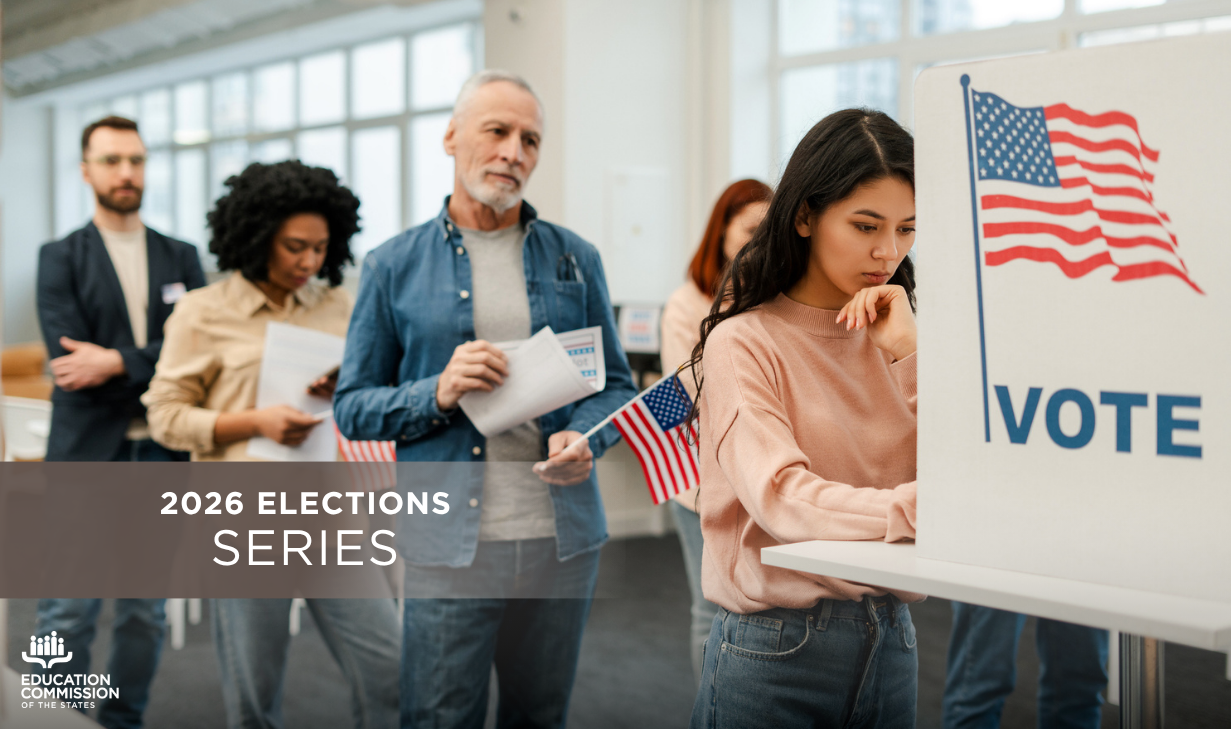
Changes in political leadership influence how education policy is prioritized, created and implemented in states and territories. As we look ahead to November, this year’s general elections are expected to have a tremendous impact on the education landscape across states.
Starting with the governor’s elections in 36 states, the U.S. Virgin Islands and District of Columbia, voters in 21 of these states and territories will see a new governor-elect take office – the highest number of guaranteed gubernatorial turnover in at least a decade. In addition to elections for governors, eight states will hold elections for their chief state school officer, and several states and territories will elect members to their state boards of education. Finally, elections will be held for members across 88 of the nation’s 99 state legislative chambers along with the legislative chambers in the District of Columbia, American Samoa and the U.S. Virgin Islands.
Together, these elections could bring new faces to the public policy table in almost every state. To help you contextualize how these elections can impact education policy and governance in your state, ECS has developed our Elections and Education Hub.
Gubernatorial Races
Thirty-six states are electing governors this year. The District of Columbia will elect a new mayor and the U.S. Virgin Islands will elect a new governor. Of those, 21 are guaranteed to see a new governor, either because of term limits, or in the case of four states and the District of Columbia, sitting governors or mayors declining to run for re-election.
Governors can impact their statewide education systems beyond just political influence. Of the 38 gubernatorial elections this year:
- 31 of the new or returning governors will hold the power to appoint at least one member of their State Board of Education.
- 15 of the new or returning governors will have the authority to appoint their Chief State School Officer with confirmation from their state senate.
- Eight of the new or returning governors will have the authority to appoint their State Higher Education Executive Officer.
In governor races, several education policy issues feature prominently across parties, including:
- Educator pay and compensation.
- Education Funding.
- Literacy.
- Workforce development and training for youth and adult learners.
While these four policy areas are most common across platforms around the country, candidates’ approaches vary across regions and parties. Democrat platforms feature childcare access and affordability more prominently, while Republican platforms are more likely to highlight the importance of family engagement and school choice.
Chief State School Officers
In addition to gubernatorial transitions, we’re also watching changes in chief state school officers. Since January 2025, we’ve seen 10 newly appointed chiefs; Missouri is also currently led by an interim chief as the search process begins there.
While some state chiefs are appointed by the governor or state board of education, there are others that are elected in a statewide election. This November will bring elections for state education chiefs in eight states — Arizona, California, Georgia, Idaho, North Dakota, Oklahoma, South Carolina and Wyoming.
In Idaho, Georgia, North Dakota, and South Carolina, the incumbents are on the ballots. But voters in Arizona, California, Oklahoma and Wyoming will elect a new chief. The sitting state chiefs in California and Wyoming, Tony Thurmond and Megan Degenfelder respectively, both ran in their states’ governors’ race but lost their party’s primary elections. Arizona’s Tom Horne also lost his primary to return as the state chief in 2027, and Oklahoma’s current Superintendent Lindel Fields, who was appointed by Gov. Stitt in an interim capacity, has independently declined to run for election.
State Boards of Education
State Boards of Education also have varying degrees of authority in states’ education policy.
Of the 36 states with gubernatorial elections this year, 27 have governance structures where the governor appoints at least one member to the state board of education. Of those, 13 states are guaranteed to have a new governor and, therefore, likely to see at least one new state board of education member.
This year, eight states — Alabama, Colorado, Kansas, Michigan, Nebraska, Texas and Utah as well as the District of Columbia and the U.S. Virgin Islands — have direct elections to choose new or returning state board of education members. The District of Columbia and Nebraska elections are officially nonpartisan, while the other jurisdictions hold partisan elections.
Legislative Elections
Of the 99 state legislative chambers across the country, 88 will hold elections in addition to the legislative bodies in American Samoa, the District of Columbia and the U.S. Virgin Islands.
New Jersey, Virginia, Mississippi, Louisiana and Puerto Rico do not have regularly scheduled legislative elections this year.
Heading into November, Democrats control 39 state legislative chambers nationwide, while Republicans hold the majority in 57. The Alaska House of Representatives operates under a unique power-sharing agreement; the Minnesota House of Representatives is currently tied with no party majority and; Nebraska’s Legislature is unicameral and nonpartisan.
Our state relations team has identified at least 155 education-related standing committees around the country. Of those committees, 114 committee chairs will reach the end of their current term after this year. As of publication, at least 28 sitting chairs will not be returning in 2027 for varying reasons, including term limits or retirement. At least six failed to advance past their primaries.
Changes in chamber leadership and, more directly, committee leadership, can impact important education policy dynamics at all stages of the legislative process.
Ballot Initiatives
Voters in thirteen states will also have the opportunity to consider education-related ballot measures that would directly impact their states’ education policy.
As of publication, there are at least 28 different measures headed to voters in 13 states:
- Four in New Mexico.
- Three each in Alabama, Arizona, Colorado and Washington.
- Two each in California, Louisiana Nebraska and Rhode Island.
- One each in Minnesota, North Dakota, Oklahoma and Vermont.
This is the largest number of education-related ballot measures that we’ve seen since we began tracking elections. The total number could still change as Secretaries of State verify and certify signatures, and as courts evaluate challenges to proposed measures.
Thirteen ballot initiatives in nine states would have a direct impact on funding for education. Five of the initiatives in four states relate to education governance issues — from district consolidation to elections and boards of regents for university and college systems. Voters in four states will consider citizen-initiated measures around gender and participation in sports.
Other ballot measure topics include school meals, curricula and collective bargaining rights for school employees.
Our Elections Coverage Continues
Election Day will answer who will hold these offices, but it will not immediately answer how education policy will change.
As new leaders prepare to take office, ECS will be watching:
- Which campaign priorities become legislative or budget proposals.
- How gubernatorial transitions affect state education leadership.
- Whether changes in legislative and committee leadership shift policy agendas.
- How states implement education-related measures approved by voters.
- Where shared priorities create opportunities for bipartisan action.
Visit the Elections and Education Hub to explore the races, leadership positions and ballot measures that could affect education in your state. After Election Day, ECS will provide additional analysis of the results and what they may mean for education policy in 2027.