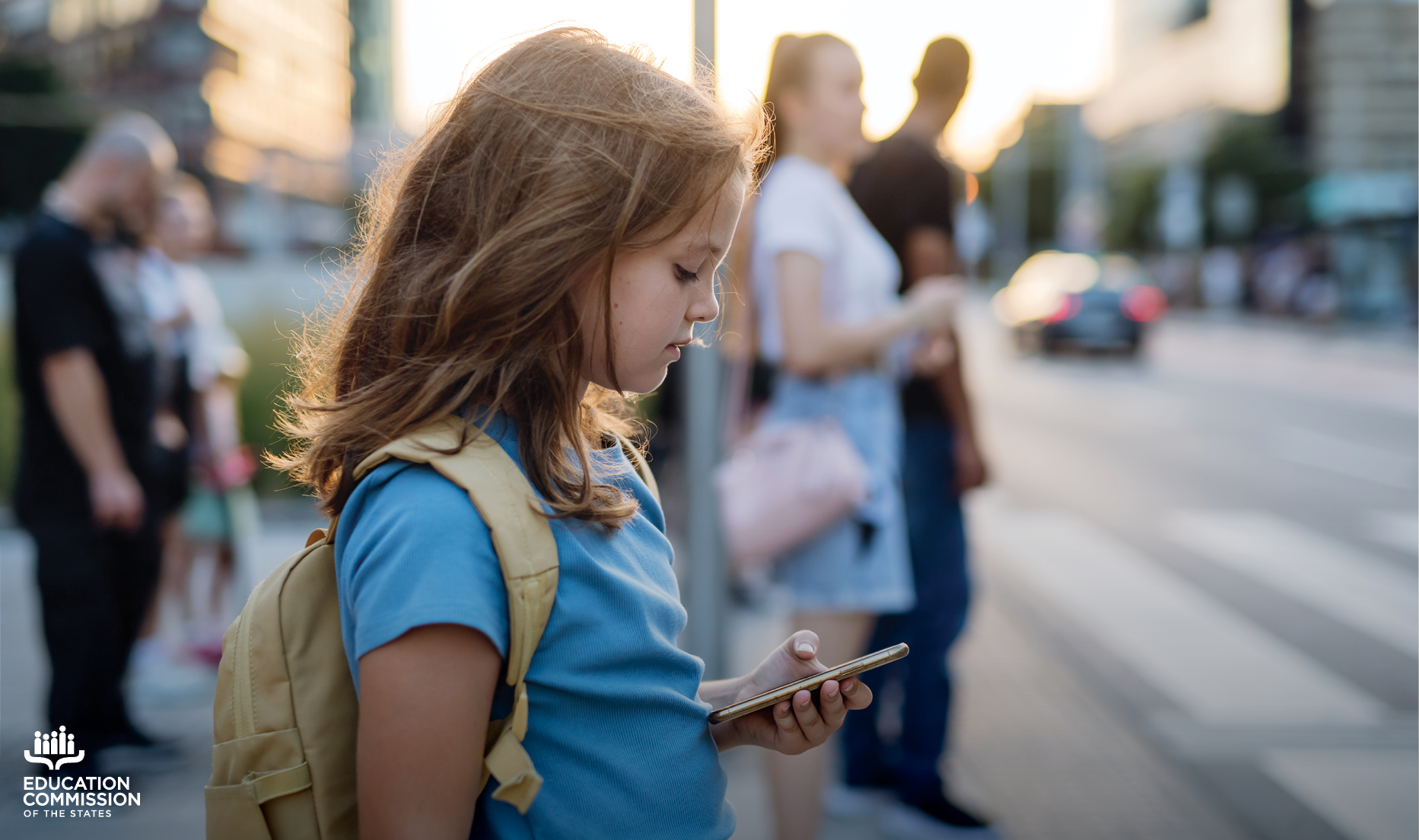
Concerns about the impact of cell phones on student learning, mental health and classroom focus have sparked state action in recent years. According to a 2025 Pew Research Center survey, nearly all U.S. teens (96%) say they use the internet every day, and the share who are online “almost constantly” has roughly doubled since 2014-15. In addition, 95% of teens report having access to a smartphone, and roughly 1 in 5 teens say they use social media “almost constantly.”
The ubiquitous presence of smartphones and students' device use in schools has spurred widespread state action to help reduce classroom distractions and improve student well-being, focus and learning. What began as a relatively small policy movement has rapidly expanded. Since Florida passed H.B. 379 in 2023, prohibiting the use of wireless communication devices during instructional time, at least 40 states have enacted policies related to cell phone use in schools.
While states share a common interest in addressing student device use, their approaches vary considerably in scope and implementation. Some states, such as Colorado, preserve local control by requiring only that local education agencies develop cell phone policies. While others, such as Alabama, require a complete prohibition on cell phone use throughout the school day. States also differ in whether restrictions apply only during instructional time or extend bell-to-bell across the entire school day.
The 2025 legislative session marked a new phase in this policy trend. More than 20 states enacted new cell phone legislation, and many states moved beyond the question of whether to regulate student device use and instead focused on refining existing policies. Recent legislative activity suggests that states are making temporary measures more permanent, extending restrictions to cover more of the school day and expanding policies to additional grade levels.
Establishing New Restrictions
Michigan: Enacted bill H.B. 4141 (2026), which requires school districts to implement a device policy prohibiting students from using wireless communications devices on school grounds during instructional time.
Washington: Enacted S.B. 5346 (2026), allowing school districts to adopt policies and procedures that limit the use of mobile devices by students. In addition, the legislature requires the Office of the Superintendent of Public Education to provide a report summarizing the policies, barriers and recommendations for student mobile device use with the intention of enabling every school district to implement a bell-to-bell cell phone policy by 2030.
Making Temporary Measures Permanent
Oklahoma: H.B. 1276 (2026) extends the requirement that each school district adopt a bell-to-bell prohibition on student use of cell phones beyond the 2025-26 school year.
Virginia: Made an earlier executive order (2024) permanent by enacting H.B. 1961 (2025), requiring each school board to develop and each elementary and secondary school to implement age-appropriate and developmentally appropriate cell phone policies for students, restricting the use on school property from bell-to-bell. The bill encourages school administrations to implement and enforce these policies and prohibits school resource officers from being involved. In addition, it prohibits the use of suspension or expulsion for cell phone policy violations.
Extending Restrictions Throughout the School Day
Indiana: Amended its cell phone policy by enacting S.B. 78 (2026), expanding device use restrictions from “instructional time” to “school day,” which is defined as the entirety of the time a student is present on school property for a student instructional day.
Utah: S.B. 69 (2026) broadens the time students may not use cellphones by redefining “school hours” to include all instructional time, lunch periods, recess and transition time between classes. The bill also requires local education agencies to develop a policy that allows parents to request accommodations for students to briefly use cell phones in a specific area of the school.
Expanding Grade Bands
Georgia: H.B. 1105 (2026) extends restrictions to students in grades 9- through 12, adding high school students to the state’s existing K-8 device restrictions.
State action on cell phones in schools shows no sign of slowing. The rapid expansion and refinement of school cell phone policies suggests that states increasingly view student device use as both an instructional and student well-being issue. ECS will continue to track how states are approaching this issue. For more information on cell phone legislation, please visit our policy tracker.