This post comes to us from Mushtaq Gunja, executive director, and Sara Gast, deputy executive director, at the Carnegie Classification of Institutions of Higher Education. All views expressed in this post are those of the authors. If you have any questions regarding changes to the Carnegie Classifications, you can contact the organization.
Since 1973, the Carnegie Classification of Institutions of Higher Education has served as the predominant framework to classify American colleges and universities. It was originally created for researchers as a way of organizing the higher education sector, but since the release over 50 years ago, the classifications have informed many policies, reporting structures and benchmarking tools. These policies, structures and tools will likely be affected by changes to the classifications starting in 2025.
Since these classifications have influence on institutional behavior and policies that govern higher education, the American Council on Education and the Carnegie Foundation have engaged institutional leaders, policymakers, organization leaders, reporters and other key stakeholders who interact with the classifications to consider updates over the past two years. In these conversations, we heard countless examples of how the classifications are baked into state and federal policy.
For example, a policy may use the classifications to define what makes an institution an associate college or doctoral university. These definitions may affect funding formulas, such as funding associate colleges at different levels than baccalaureate colleges. Faculty pay can be impacted by an institution’s Carnegie Classification as can state performance funding. Some states provide additional funds for institutions to pursue a Carnegie research designation. And there are some federal grants that are restricted to R2 or to non-R1 institutions.
Beyond funding, accrediting agencies often use the classifications in determining peer groups or site visits. State and federal agencies may report data by Carnegie Classification grouping, and it can be a useful comparison tool to see how an institution sits within a national context. They also are part of the underlying methodology for the U.S. News and World Report Best Colleges lists. In short, the Carnegie Classifications have an influence on institutional behavior and on the policies and systems that govern U.S. higher education – and that is why we want to make sure policymakers are aware of what is coming.
As stated above, most of these use cases will be impacted by changes to the classifications starting in 2025. Our November 2023 announcement described how the classifications are being modernized to more accurately describe and classify the current higher education landscape. That means policymakers might want to examine statutes, higher education policies and regulations for Carnegie names and terms so they understand where these changes will impact their decisions, policies or implementation processes.
Excitingly, we are also looking to do more than just modernize the existing structure. We are creating a new classification system that groups institutions by the social and economic mobility that they provide students. At a broad level, the classification will group similar types of institutions and look at the access they are providing to students as well as the outcomes those students experience. As policymakers consider how they want to make funding and governance decisions, this new system could be a lens that better aligns with their strategic priorities than the legacy classification.
We welcome ideas and suggestions from users of the classifications, particularly policymakers, on how to make them more useful. Please use this feedback form if you would like to participate.
A rise in the number of school shootings over time has increased focus on school safety, adding to other longstanding school safety concerns, like fighting or bullying. In addition to immediate physical harms, school violence can have long-lasting effects that undermine students’ engagement and mental health.
There is widespread agreement that addressing safety threats in school settings should be a priority — something Congress signed off on with the passage of the Bipartisan Safer Communities Act in 2022.
In a recent Learning Policy Institute report, we examined the evidence behind school safety improvement strategies, which fall into two broad approaches: increasing physical security and building supportive school communities.
Improving Physical Safety and Building Supportive School Communities
Our report found that strategies to increase physical security, including using metal detectors, employing school resource officers or arming school staff, were largely ineffective at preventing firearm incidents or reducing school violence. Strategies like controlling building access and badging staff and visitors were not studied.
Building supportive school communities to protect against school violence is increasingly considered an effective strategy. Indeed, strategies such as increasing access to mental health resources, adopting social and emotional learning practices, implementing restorative practices, and adopting structures and practices that foster strong relationships have been found to significantly reduce school violence and improve school climate.
While mental health services and counseling have been shown to benefit students and schools, schools' capacity to provide these services is strained. On average, public schools have one counselor for every 408 students, one school psychologist for every 1,127 students and about 42% of schools offer mental health treatment services.
In co-sponsorship with Education Commission of the States and AASA, The School Superintendents Association, LPI hosted a webinar series to learn directly from state and district policymakers, educators and experts about effective policy approaches and high-impact investments that can help create schools that foster student safety and well-being. The first of these webinars covered how schools can create both physically and psychologically safe learning environments for students, while the second focused on the use of restorative practices.
Key lessons from these resources suggest that state policymakers could improve school safety by:
States can also adopt high-impact strategies through:
All students deserve a safe and healthy school environment where they can thrive. With meaningful investments using the new influx of federal funds, states and school districts have an opportunity to foster these environments for their students.
Over the past two years, the Arts Education Partnership and Education Commission of the States have collaboratively led a preschool through fifth grade STEAM education initiative for state leaders around the country. We feature new resources, research, convenings and technical assistance for policymakers to take advantage of. As the next convening approaches — as an invite-only ancillary event at ECS’ National Forum on Education Policy — we’d like to share a few STEAM education resources to inform your work and a sneak peek into the upcoming event.
Our resources aim to educate state policymakers and raise awareness around a variety of issues, including equity and access, governance and the benefits of high-quality STEAM education — we’ve even had a little fun too! Below are a few of our most recent related resources:
In addition to our current resources, we’ll develop more shared understandings and discuss the transformative potential of STEAM education at our convening in July.
Our summer workshop will provide the following insights:
As we look ahead at the next phase of this work, AEP and ECS will publish three new case studies elevating exemplary work from around the country and develop new policy resources. We’ll also lead a community of practice and technical assistance network with four to five states to help them learn, collaborate and build up STEAM education in their states.
Be on the lookout for a new policy resource on the state of early numeracy. It will feature recent research and state examples around reversing troubling recent trends!
The Rhode Island Department of Education began the process of changing the state graduation requirements as a result of the analysis of the Rhode Island high school student experience provided by the XQ Institute. The analysis found that while eight out of ten high school seniors wanted to attend a two- or four-year college, only six out of ten were enrolled in the high school courses they needed to be eligible.
This misalignment between high school graduation requirements and the state’s postsecondary admission requirements resulted in a systemic breakdown for students. This breakdown led the department to reimagine the high school experience with the leadership of Angélica Infante-Green, commissioner of education.
In 2021, the department established an Office of Reimagining High School and embarked on an 18-month process to eliminate the mismatch between what students wanted after graduation versus what high school required. The department leadership knew that they would need the support and input of the community across the state to implement the kind of possibilities the new graduation requirements could provide.
To engage all the stakeholders — teachers, parents, students, labor unions, business and nonprofit leaders — the department hosted a series of Reimagining High School meetings that were open to the public. Guided by the notion that department leadership did not want to be right, instead they wanted to get it right, they remained flexible, devised solutions and committed to addressing community concerns.
The result of the community input provided the basis for the new proposed graduation requirements presented to the public in February 2021. After an extended public-comment period, the department received over 400 comments on the proposed graduation requirements. This is the most public comments ever received on K-12 education regulations in the state. The new graduation requirements developed from this effort were presented to the Rhode Island Council on Elementary and Secondary Education, which passed unanimously on Nov. 15, 2022.
Highlights of the new graduation requirements include:
Other notable graduation requirements include:
The new statewide requirements ensure that all high school students who graduate have the necessary building blocks to apply to postsecondary education or pursue a career. The meaningful community engagement that fueled the process allows the Rhode Island Department of Education to continue the conversation with stakeholders to realize the implementation of the complete five-year action plan.
In 2019, Georgia Gov. Brian Kemp elevated the need to better recruit and retain special education teachers after a listening tour with State School Superintendent Richard Woods and district superintendents. According to state data, about 20% of special education teachers were turning over each year. National data clearly shows that schools struggle with persistent and specific teacher shortages — especially in special education. Georgia state leaders are using an innovative program to respond to these challenges.
An analysis of the Georgia Teacher Academy for Preparation and Pedagogy, an alternative certification program, found about half of teachers placed in special education transitioned to general education roles after two years. A 2022 report on Georgia teacher burnout investigates causes for teacher turnover, including the challenges of large caseloads for special education teachers.
We recently spoke with Wina Low, Georgia’s state director of special education services, about the Georgia Teacher/Provider Retention Program (TPRP). Low shared the initial success of the program in supporting and retaining special education teachers by providing the tools they need to be successful through induction and mentoring. The program focuses on keeping new special education teachers in the classroom and Low has high hopes for its continued growth and improvement.
A grant from the U.S. Department of Education’s Office of Special Education Programs provided an initial influx of $500,000 per year for up to five years to launch the program, which was developed in partnership with local higher education institutions and experts in the field.
The Teacher Model Induction Program uses a train-the-trainer model with content developed by the Georgia Department of Education with the Center on Great Teachers and Leaders and Kennesaw State University. The Georgia Learning Resource System staff were trained and took what they learned about high-leverage practices back to their local communities. GLRS is a network of 18 regional programs that provide training and resources to school district personnel and other community members to support students with disabilities.
The program has seen promising results in its first few years of implementation. Among the teachers who completed the program in the 2021-22 school year, 84% were retained for the next school year; this is higher than non-completers (74%). Additionally, 89% of program participants who responded to the survey agreed or strongly agreed that the TPRP professional learning influenced their decision to continue teaching special education. A teacher in the program said, “The coaching I have received from the Teacher Induction Program has impacted my instruction by giving new strategies to best help my students and their learning in the classroom.”
While participating in the program, teachers received targeted support such as coaching, training on content and practicing skills using Mixed Reality Simulation — a virtual reality practice setting that allows for role-playing. A teacher said, “Having a mentor really helped me plan accordingly to meet the needs of all my students. Any questions or concerns that I had were discussed and sound advice was given to help me maximize my teaching time.” In the first year of the program, teachers work on strengthening skills like instruction, meeting with school leaders and writing strong Individualized Education Programs for students
Now in its third full year of implementation, Low is optimistic about the future of the program. She hopes the program will move into a two-year format to allow teachers to continue receiving support in the first crucial years of teaching. Special education directors are also being supported by the program, which will continue to build a strong environment for new special education teachers.
As state leaders look for ways to boost teacher retention, Georgia’s model demonstrates the importance of analyzing local data to understand the challenge at hand, targeting solutions to support the specific population of teachers in need and leveraging partnerships to build capacity within the system. To learn more about Georgia’s work, consider watching this webinar on the TPRP model.
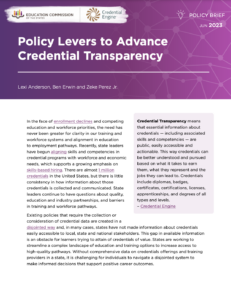
There are nearly 1 million credentials in the United States that students and workers can take advantage of, but how information about these credentials is collected and communicated is oftentimes inconsistent and hard to access. In February, we invited a group of postsecondary and workforce development experts to consider how policymakers can leverage credential transparency to further state workforce and attainment goals. Inspired by those conversations, this Policy Brief highlights data capacity, governance and funding as key policy areas and provides considerations that states, systems and practitioners can use to develop credential transparency. To learn more:
Elementary and secondary school construction — referred to here as capital school construction — is the nation's second-largest capital investment for state and local governments. It is surpassed only by road construction. This funding's main objective is to ensure students have access to modern, updated facilities that facilitate learning and development. While local governments are responsible for most school construction costs, state governments have played a significant role in financing the construction of school buildings.
State governments provide financial support for school capital construction through direct appropriations and financing support. Securing adequate funding for school infrastructure is crucial for schools to maintain and enhance their facilities. However, during periods of budgetary constraints, school construction funding may face challenges and not be prioritized. So, funding may be reduced or delayed, adversely affecting schools' capacity to provide safe and modern learning environments for students.
In this review, capital school construction is defined as major facility projects that involve the construction of new structures or major renovations. This may involve planning, design, site acquisition or the retrofit and replacement of buildings. These expenses are typically funded through the capital budget and often financed with bonds. Not discussed here is funding for maintenance and operations projects that involve regular, routine facility work, such as cleaning, grounds keeping, minor repairs, utilities and building security.
Explore the 50-state comparisons below to see how states provide funding through appropriations and financing support, while exercising authority through oversight and prioritization. View a specific state’s approach by going to the state profiles page.
Click here to see all data points for all states
View individual state profiles on state k-3 policies by selecting a state below or view 50-State Comparisons on each data point.
Following a high-quality early care and education experience, the kindergarten-through-third-grade years set the foundation upon which future learning builds; and strengthening this continuum creates opportunities for later success. Key policy components of a quality experience in K-3 include school readiness and transitions, kindergarten requirements, educator quality, and prevention, intervention and assessments.
Education Commission of the States researched the statutes and regulations that guide these key components in all 50 states to provide this comprehensive resource.
Click on the questions below for 50-State Comparisons showing how all states approach each policy, or view a specific state’s approach by going to the individual state profile page.
All Data Points for All States
View individual state profiles on state k-3 policies by selecting a state below or view 50-State Comparisons on each data point.
Copyright 2026 / Education Commission of the States. All rights reserved.