
The precursor to this post described a bridge to nowhere — a Los Angeles area structure left stranded when the roads connecting it washed away. It's a useful metaphor for the challenge facing state and local educators today: the educational roads they build to jobs are constantly being washed away by the tides of technological change.
Artificial intelligence is more of a tsunami than a mere tide.
The result? Policymakers struggle to make long-term investments in education and workforce systems amid significant uncertainty. The question is no longer simply: “What should states invest in?” The question is “How can states make informed investments when AI technologies are changing the labor market so quickly?”
The Industries of Ideas (IofI) initiative is working with educational policy makers to help light a path forward.
The Problem Isn't Just AI, It's Measurement
Whether AI disrupts the labor market gradually or rapidly, state leaders need timely, local, and actionable data systems to track changing skill demands, identify trends in shifting labor markets, and steer people toward timely, relevant credentials.
Unfortunately, many of the data systems policymakers rely on for these insights weren't built for this moment.
Survey response rates have declined. Long-established projection methods weren't designed to measure rapid technological change. Few systems can track how the content of jobs is shifting even when job titles stay the same.
The result is a policy problem embedded inside a data problem: states are making multi-year investments in credentials and training pathways without a complete picture of where their local economies are heading. Going back to the metaphor, we are driving down a dark road where the bridges might have been washed away, and we need better headlights.
The good news is that states have the data and the capacity to build those headlights.
Industries of Ideas’ Local, Forward-Looking, Actionable Approach
Funded by the National Science Foundation (NSF)’s Directorate for Technology, Innovation and Partnerships, the Industries of Ideas project takes a new approach to producing those headlight measures. They are taking Robert Oppenheimer’s saying “the best way to send knowledge is to wrap it up in a person” to the data. They use university data on NSF research investments, which drove the emergence of AI and other critical and emerging technologies, to characterize university innovators – the “ideas” people who have worked on and been trained by those research investments. The AI innovator information can be combined with workforce information data to characterize which employers are actively hiring those innovators – the changes in the workforce by these AI-active employers are the “headlights” that are needed.
This innovative approach to characterizing AI active employers and the workforce changes can be used to help states measure AI's impact on local economies. It traces how AI expertise flows through universities, through both researchers and students, into specific employers in local economies. Three states – Arkansas, Ohio and New Jersey – are piloting these measures and getting guidance from expert advisory boards established by the Education Commission of the States, the National Association of State Workforce Agencies and the Center for Regional Economic Competitiveness.
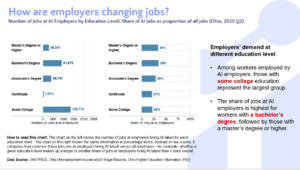
For state education policymakers, the result is a new category of evidence: actionable, local intelligence about which credential and training pathways are connecting learners to employers that are actively adopting and developing AI technologies, and new information about the value those pathways create for prospective hires.
Data infrastructure is only as valuable as the decisions it informs. Industries of Ideas are designed from the start to engage. State agencies, governors' offices, education and training providers, workforce organizations and economic development leaders are active participants — not just recipients of findings — and help shape which products, questions and methods the initiative pursues, which means the outputs are calibrated to actual state policy needs rather than research interests alone.
A New Kind of Evidence for State Policy Decisions
State education leaders are increasingly expected to demonstrate that postsecondary investments produce measurable labor market value. That’s a reasonable expectation, but to meet that expectation, states may need better tools than they currently have – at recent Industries of Ideas convening of nearly 200 state, federal, academic and business leaders, more than 80% reported that they lacked the data needed to address AI's effects.
Industries of Ideas can help answer questions such as:
- What are the characteristics of AI-active employers in your state?
- Which postsecondary programs in your state have completers being hired by AI-active employers?
- What are the earnings for these new hires?
- What kinds of AI research investments in your universities flowing into regional economies?
These aren't hypothetical capabilities. They are the kinds of analyses the initiative are already conducting and expanding.