Over the past five years, governors have been pretty consistent when it comes to education issues featured in their state of the state addresses. However, they have completely shifted on what they prioritize within those issues. From COVID-19 pandemic recovery to career and technical education, states are continually redefining what success looks like in education.
For over 20 years, Education Commission of the States has tracked education priorities in governors’ annual State of the State addresses.

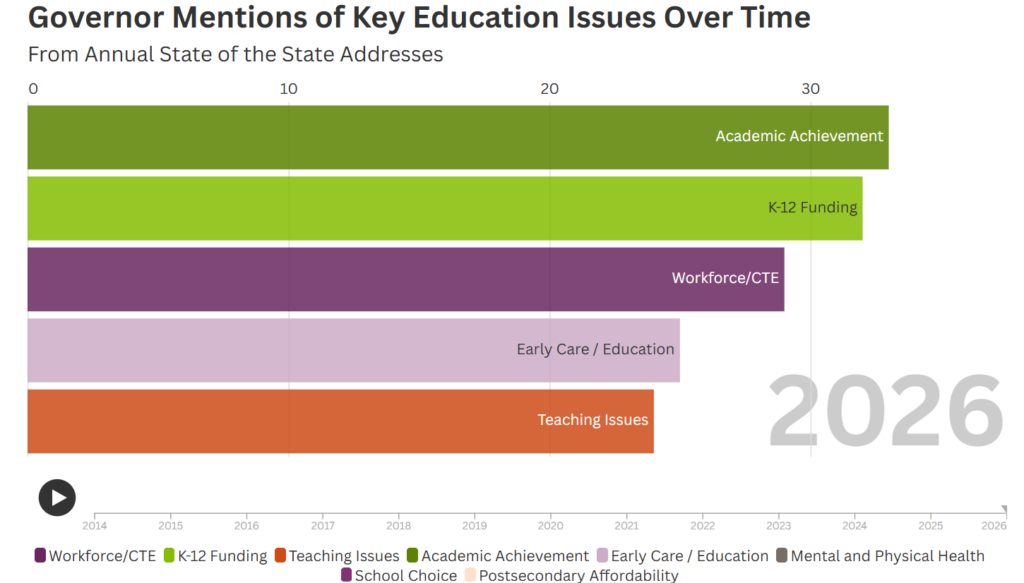
Through the years, our team has examined proposals to understand their significance to each state’s policy agenda and priorities. With the launch of our 2026 report on governors’ education priorities, a look back at past addresses reveals how governors’ priorities have shifted, and what priorities have shifted the most, even within just the past five years. Early Childhood Education and Teacher Staffing have also been in the top five issues since 2020, yet governors priorities were more consistent.
K-12 Funding
K-12 school funding has been one of the top issue areas mentioned in governor’s State of the State addresses since 2021. It’s no surprise that K–12 funding remains front and center. It’s often the largest line item in state budgets. What has changed is how governors talk about it.
Funding ranked as the top issue from 2021 through 2023. In the first two years, governors primarily highlighted the use of federal COVID-19 relief dollars to support specific student groups and programs during the height of the COVID-19 pandemic. As spending cliffs approached in 2023, governors emphasized increased investments, proposed additional allocations and announced reforms to state K-12 funding formulas.
In 2024 through 2026, K-12 funding ranked second. During these years, many Governors celebrated historic increases in K-12 investments. Some governors also mentioned reforms to K-12 funding with targeted efforts to support specific student populations like English Learners or students in high-poverty districts. In 2026, the topic was mentioned by 32 governors.
K-12 School Funding Spotlight:
- Idaho Gov. Brad Little noted that public school funding was not cut after the state forecasted a revenue decrease and that support for public schools has increased 70% during his time in office. He also noted that his budgets have added more discretionary funding for public schools.
Workforce Development and Career and Technical Education
Workforce development and career and technical education (CTE) has steadily climbed to become a top issue area in recent years, ranking as the top issue in both 2024 and 2025.
In 2021, governors emphasized the important role of workforce development policies in ensuring all of their constituents individuals in the state have access to high-quality work and learning opportunities. This was framed mostly around workers impacted by the COVID-19 pandemic. In 2022 and 2023 the issue ranked second, with governors proposing additional funding for workforce training programs or CTE, highlighting successful apprenticeship programs and emphasizing programs that increase workforce participation in high-demand fields.
In 2024 governors discussed how these programs and proposals could strengthen their state’s workforce and prepare students for careers in in-demand fields such as health care or teaching. Similarly, in 2025 governors discussed internships and apprenticeships as vehicles for young people to gain real-world skills that prepare them for workforce demands.
As of 2026, workforce development and CTE ranked third, mentioned by 31 governors. Many governors in 2026 highlighted substantial growth in CTE enrollment and new or continued investments in workforce development and CTE programs.
2026 Workforce Development and CTE Spotlight:
- Pennsylvania Gov. Josh Shapiro celebrated the expansion and increased investment in vocational-technical programs, Career and Technical Education, and apprenticeship programs by 50 percent. Specifically, Governor Shapiro called for an increase to Career and Technical Education funding by $18 million this year for a total investment of over $200 million.
Academic Supports and Achievement
Academic supports and achievement was mentioned by at least 35 governors in 2026, making it the top issue despite ranking fourth or fifth in most previous years.
In 2021, the issue area ranked fifth with governors primarily discussing strategies to address interrupted instruction caused by the COVID-19 pandemic. Specifically, governors expressed concerns about shifts from in-person to remote education and how opportunity gaps disproportionately impacted student achievement. In 2022, this issue area missed the top five (it ranked sixth), however, in 2023, it returned to fifth. Also, in 2023, governors shifted away from discussing impediments to student learning to supporting learning and performance through academic supports.
In 2024, academic supports and achievement again ranked fifth with governors highlighting initiatives such as intensive tutoring, increased funding for academic progress plans, efforts to support comprehensive testing plans and early literacy initiatives. In 2025 it rose to fourth as governors focused in on literacy and science, technology, engineering and math (STEM) initiatives. For instance, governors stressed the importance of early literacy skills for life-long achievement, highlighted the science of reading as a major contributor to building early literacy skills and emphasized the importance of STEM education on foundational math proficiency.
By 2026, Academic Supports and Achievement was the number one issue area, with 35 governors. While some governors highlighted student achievement in multiple areas, others continued to call for improvements and to maintain high standards. Many governors continued to stress the importance of early literacy, especially the evidence-based science of reading. Some governors signaled an interest in expanding math instruction and celebrated increasing high school graduation rates.
Academic Supports and Achievement Spotlight:
-
- New Mexico Gov. Michelle Lujan Grisham reported that the state’s literacy initiatives — including a literacy institute, science of reading programs and intensive tutoring — served 17,000 students and contributed to an 8% increase in literacy proficiency.
While no one can predict exactly what the next five years will bring, the direction is becoming clearer. States are moving beyond recovery and toward transformation, investing in workforce pathways, doubling down on student outcomes and rethinking how systems deliver results. For policymakers, the opportunity is not just to respond to these shifts, but to learn from them, and act on what’s working.