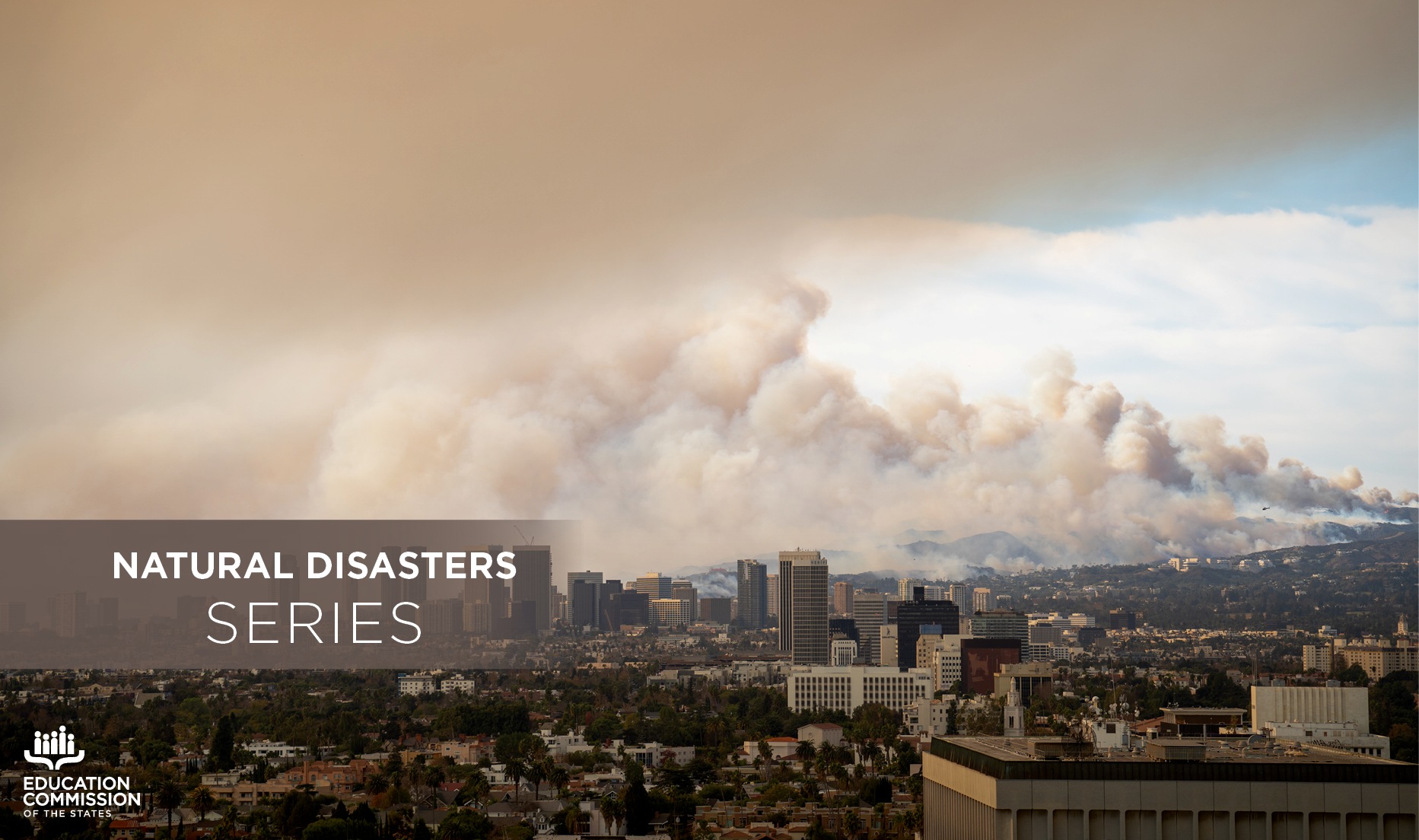
In January, destructive wildfires spread across Los Angeles — displacing approximately 150,000 residents and causing serious damage to homes, businesses and school buildings. Over eight months later, the city is still rebuilding.
Natural disasters are not a new phenomenon, but they are a growing one. The annual number of billion-dollar weather and climate disasters in the United States has increased sharply over time — hitting a record high of 28 in 2023. These disasters, which include droughts, floods, freezing, severe storms, tropical cyclones, wildfires and winter storms, impact nearly every aspect of life for affected residents, including education.
Disaster-related displacement and facility destruction often lead to prolonged school closures that significantly disrupt student learning. Hurricane recovery research indicates that negative impacts of severe weather events (e.g., test score declines) affect all students irrespective of demographic group. These harmful effects can also reach beyond immediate achievement by impacting postsecondary enrollment, years of schooling and earnings later in life.
However, strong state policies developed to prepare for the effects of natural disasters can help mitigate the negative effects of a disaster on students’ academic progress. Several states have introduced legislation in recent years to proactively prepare for the effects of natural disasters in education using a range of approaches, including district-level instructional continuity planning, student-level emergency planning, expedited facility repair provisions and virtual learning. These policies ensure that every district is prepared for an emergency while still providing flexibility to addressing their students’ needs.
State Examples
California law requires each district to include an instructional continuity plan in its comprehensive school safety plan to ensure ongoing student access to instruction during emergencies. The plan must include procedures for student engagement within five calendar days following the emergency. The plan must also provide access to in-person or remote instruction within 10 instructional days following the emergency. In addition, state statute allows the Legislature to expedite repairs to school facilities damaged or destroyed by natural disasters to return facilities to usable conditions quickly.
In 2021, Maryland passed legislation requiring that every individualized education program (IEP) include a learning continuity plan to ensure students with disabilities continue receiving required services in emergency conditions. In 2023, the state passed another bill allowing county superintendents to provide virtual education days to students instead of closing public schools in the case of a severe weather event.
North Carolina law allows a district to use up to five remote instruction days (or 15, for districts located in a county that has received a good cause waiver from the state) when schools are closed due to severe weather conditions, energy shortages, power failures, or other emergency situations. In addition, the governing board of a district that plans to use remote instruction in these situations is required to annually submit a remote instruction plan. This plan must include information on resources that will be used to facilitate remote instruction, communication and training with staff, parents, and students on how to access and use remote instruction resources, establishment of staff roles and expectations, attendance tracking methods, development of options for teachers and students with limited connectivity, and the provision of remote instruction supports for students with disabilities.
Though these types of emergency preparation provisions do not exist under statute or regulation in many states, some provide relevant guidance and resources for districts to adopt if they choose. For example, Florida doesn’t require districts to develop instructional continuity plans but provides a manual, template and other resources related to these plans for districts to access as necessary.
As natural disasters continue to grow in frequency and severity, preempting disaster-related interruptions remains a critical responsibility of education leaders. While no one-size-fits-all approach exists, many states are already preparing for natural disasters with policies that aim to minimize their fallout by establishing procedures that streamline the rebuilding process and providing for learning continuity when a disaster hits.